Take one sip.
Or put water within reach and leave it there.
Your choices stay in this browser. Nothing is sent anywhere.
When the next step does not fit
Start here. Ten seconds, no words needed, and you can stop straight after.
That is a complete visit. You can close this page now.
If you would rather carry on: this is a book, and it exists. £34.99 on paper, £8.99 on Kindle, free on Kindle Unlimited. Nothing above this line costs anything, and nothing below it is required.
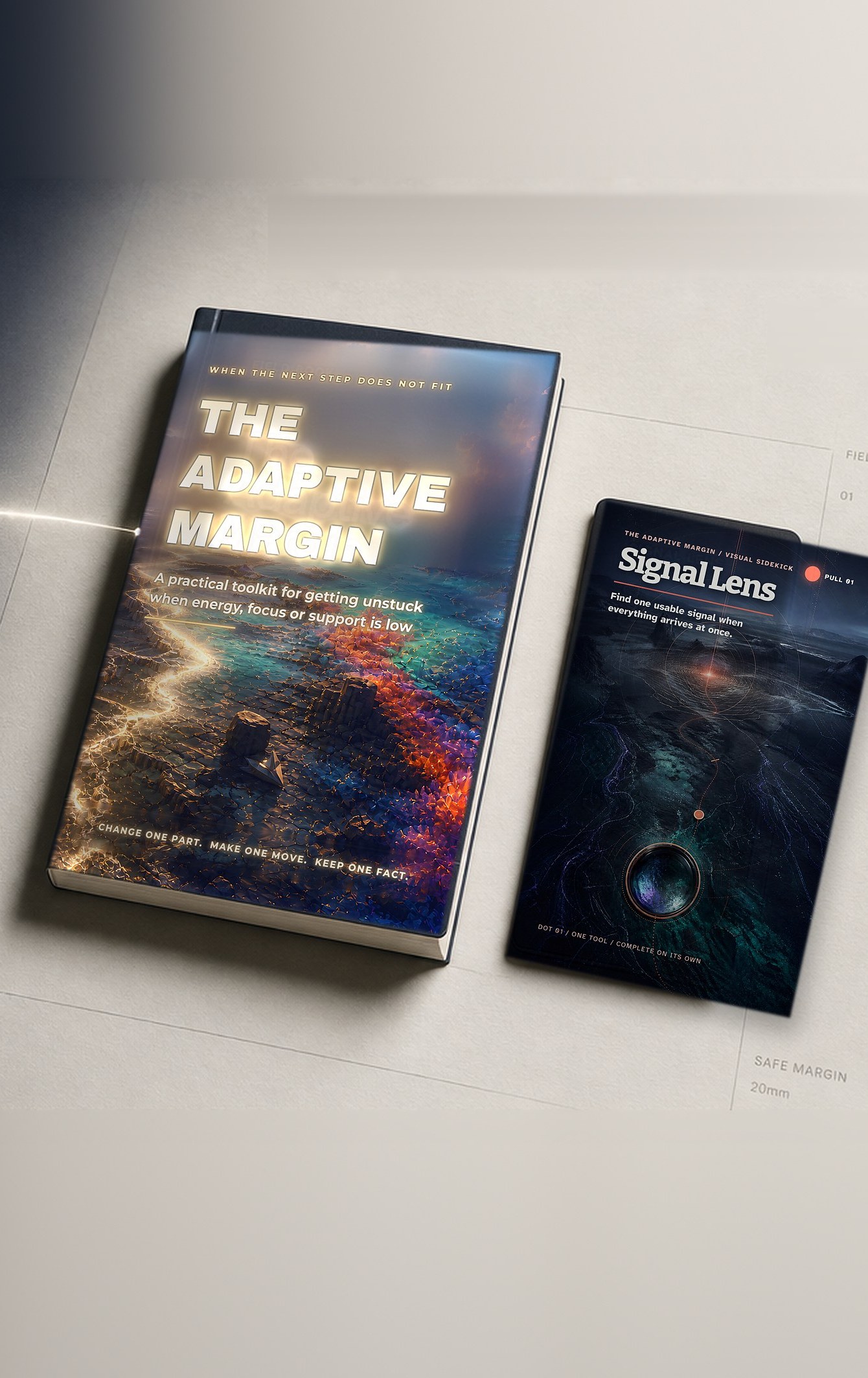
Visuals of the book and the v5.0 Signal Lens. A proof copy is ordered. These become photographs when it lands.
An email you cannot open. A room you cannot start. A task you cannot return to. What can change?
No scores.No streaks.No required order.Change one part. Make one move. Keep one fact.
00 · Start here
The person is not the only thing that can change. Pick the easiest one and stop as soon as it exists.
The result can be tiny. One changed fact is enough. No writing. No explanation. No need to continue.
Or put water within reach and leave it there.
Open it, close it, or move nearer. Any of the four counts.
Put it where the next act can find it later.
Field Card 00 · Free · Yours now
Three acts on one page. No app. No account. No reminder. No price. Print it or photograph it, and this website is no longer needed.
Any one of these on its own is a complete visit. Field Card 00, The Adaptive Margin, theadaptivemargin.com
The only thing here you can have today, and it costs nothing. The paperback is £34.99 and the Kindle edition £8.99, both out now.
01 · What it actually does
Find the exact point where a task catches.
Make one real-world move smaller.
Change the place, people or timing.
Return without protecting a streak.
Keep one useful fact about what changed.
Read, point, cover, mark, fold, cut, rip or leave every page intact. Writing is optional. Fourteen printed tools and bound alternatives are included, so nothing closes because of a hand or a day.
02 · Ways in
Choosing, starting, continuing, returning, changing the conditions, noticing, discovering, or not knowing what you need yet.
These name doors, not chapter order. You are never asked what you are, only what is catching today.
Nothing has to be named. This way in assumes you cannot yet say what you need, and it does not ask you to.
For when something is off and it has no shape yet. We widen the view a little, without asking you for a conclusion.
For when there are several possible next things, and the choosing itself has become the thing that catches.
For arriving. Starting is kept apart from continuing, because beginning and carrying on are different jobs and need different pages.
For when something is already going, and the question is how to keep contact without starting the whole thing again.
For when the move is fine and the room is not. We change what is around you rather than what is in you.
For coming back after a gap of any length, with no backlog to clear and no explanation owed.
For keeping evidence. This is where one changed fact gets recorded, and where anything unhelpful gets thrown away.
Marks show what each way in carries. In the book you find the pages with the printed edge index, not by reading from the front.
03 · The loop
Three beats, in the same order, on every way in. It is a loop, not a ladder. Beginning in the middle still counts, and rest does not erase what you kept.
Something catches.
One part can change.
One move becomes available.
One fact is different.
Capacity changes
The book adapts the move. It does not grade the weather.
Cognitive offloading, implementation intentions, attention research and choice architecture inform specific design decisions. They do not prove that this product has clinical effects. No adult SEND study has been run yet. One is a release gate, and so is physical testing.
04 · Inside the book
Two hundred and thirty pages in six working parts. Open the stack and take each one out.
Open the stack, then take out any part to see what it does. Nothing here needs to be understood in order.
Read, point, cover, mark, fold, cut, rip or leave every page intact. Writing is optional. Every cut has a bound alternative that needs no cutting at all.
Inside: eight ways in, fourteen physical tools, places to write, a hidden page-jumping mystery, and twenty-two pages of Wonder Leave. Use what helps. Leave the rest.

The v5.4 front cover, as it goes to print.
Out now
The paperback is the object this book was designed as: fourteen tools you can cut out, a bound alternative for every one, and a colour index printed on the outer edge. The Kindle edition carries the whole text for £8.99, and is the cheap way to find out whether the paper one is for you.
Buy the paperback£34.99 Or read it on Kindle£8.99 Free on Kindle Unlimited. Amazon takes the payment, not us.

Collectible 01 · Visual sidekick
Open this when the field is too loud. Find one signal that can change the next minute. Point, cover, place, or leave it closed.
No streak. No diagnosis. No debt. Use it alone or slide it beneath the Dot Dock band on the main field book.
Point to one signal
You belong before the signal is clear.
Choose one signal, not a complete explanation. Nothing you point at is stored.
Dot Dock
Field Card 00 is on this page and costs nothing. Signal Lens is drawn and not out. Six slots are empty and honest about it. Nothing you own now becomes incomplete when the rest arrive, and no dot is ever required.
06 · One family, no lock-in
Every edition stands on its own. Nothing that comes afterwards turns anything earlier into a partial product.
The complete method, Wonder Leave and fourteen bound tools.
Retail candidateCollectible 01. A visual-first sidekick. Digital first, print after its own gates.
Deployment candidateFind the first physical place where an intended action stops.
Future editionResume from the nearest live point without paying a backlog.
Future editionOne new digital sidekick each month, or choose nothing. No streak, backlog or status.
Not open07 · Where it is
Both editions out now
Books carry no VAT in the UK, so those are the prices you pay. Two of five tests settled, one in the post, two not yet.
There is no checkout here and there never will be. Amazon takes the payment and handles returns.
This went on sale before every test was finished. That is a choice, and this is the whole of it. We will not replace missing evidence with launch language, so here is the log instead.
230 interior pages and 24 Signal Lens pages pass structural, margin, font and mechanism checks. Passed on v4.9.
Print colour, binding, trim, edge index and every construction page tested in the printed object. A copy is ordered. It has not arrived. When it does, the renders here become photographs of it, good or bad.
Tear, fold, place, close, shake and repeat. No reverse-side content can be lost. Nothing here starts until the copy is in a hand.
Real readers decide whether the pages feel like company or weight, and whether each first move is understood. No study has been run. Nothing is claimed on the strength of one.
Price, territory, fulfilment, cancellation, returns and payment security sit with Amazon, not with us. Your card never touches this site. Amazon's returns policy applies, not ours.
Two settled, one in the post, two not yet. This log moves when a test moves, including when one fails. Nothing here gets quietly deleted.
08 · What readers say
Printed as they were written. Nothing added and nothing sharpened.
All four were given a copy of the book. Nobody was paid, nobody was promised anything, and nobody was asked for a particular answer. That is declared here rather than in a footnote, because a review copy you are not told about is the thing worth hiding.
A fifth was offered and is not here, because it could not be verified. The shelf holds what can be stood behind.
Occupational therapist · clinic
I stopped asking families for a “home programme.” I give them the three acts and tell them the session is finished when they put the book down. Two parents have brought it back with the spine already broken at the leave pages. That is the outcome I wanted.
Teacher · Year 4
I used the signal picker on a wet Friday instead of a mindfulness video. The room got quieter without me performing calm. I did not laminate anything. I did not start a display. That felt like the point.
Designer · product
I have shipped streak counters for a living. Page 198 made me take the price off the fifth screen of a client site and put it under the first honest sentence. The client did not leave. A few did. Both results are in the book.
Reader · Kindle Unlimited
I opened it on KU because it was free and closed it at the permission page. That would be a failed conversion anywhere else. Here it is the conversion. I bought the paper copy the next week so I could put it down with my hands.
That last line is not a style preference. Since April 2025 a review that does not reflect a genuine experience has been unlawful in the UK, and the regulator can act without going to court. A book whose sales page carries a public log of its own unfinished tests is not going to invent the one thing it cannot yet manufacture.
If you have read it and want to say something, honest or otherwise, use the form below. Nothing is offered in return and nothing is edited except length, with your agreement.
Stop here
You can close this page now. Nothing is saved anywhere but your own browser, nothing is counted, and nothing is waiting for you when you come back. If one physical fact is different, that was the whole thing.
If you would rather carry on, the rest is below.
This book is not a crisis service, and it never will be. These are.
Both editions out now
Both editions are out. The £34.99 paperback is the object itself, and the £8.99 Kindle edition is the whole text and free on Kindle Unlimited. Leave an address and you get the accessible EPUB, free, whether or not you ever buy anything.
Buy the paperback£34.99Kindle£8.99
The paperback is £34.99 and the Kindle edition £8.99, free to read on Kindle Unlimited. Both are out now on Amazon, who print it, post it and take the payment. Your card never touches this site, and your rights as a buyer sit with a company that has to honour them.
We could have opened a checkout here and taken your card. We did not. Amazon does that part better, and it means one less place your details can sit.
Registering costs nothing and commits you to nothing. There is no queue you have to pay to leave.
Change one part. Make one move. Keep one fact.